
East of Eden

Director Elia Kazan was looking for a new young actor to play the role of Cal in East of Eden. Dean and another relatively unknown actor, Paul Newman, were the final two chosen. Following a screen test in New York City, the part was given to Dean (a portion of the screen test in which the two joke in a homoerotic manner can be seen here).
On March 8, 1954, Dean left New York City and headed for Los Angeles to begin shooting East of Eden. The film is based on the 1952 novel of the same name by John Steinbeck, which dealt with the story of the Trask and Hamilton families over the course of three generations, focusing especially on the lives of the latter two generations in Salinas Valley, California in the mid-1800s through the 1910s. The novel was adapted for film by screenwriter Paul Osborn and director Elia Kazan and dealt predominantly with the character of Cal Trask, of whom Elia Kazan said before casting "I wanted a Brando for the role." He eventually cast Dean for the role of Cal, who is essentially the rebel son of a constantly disapproving father (played by Raymond Massey) and prostitute mother (Jo Van Fleet). Dean's performance in the film foreshadowed his role as Jim Stark in Rebel Without A Cause. Both characters are rebel loners and misunderstood outcasts, desperately craving parental guidance from a father figure.
Much of Dean's performance in the film is completely unscripted, such as his dance in the bean field and his curling up and pulling his arms inside of his shirt on top of the train during his ride home from meeting his mother. The most famous improvisation during the film was when Cal's father rejects his gift of $5,000 (which was in reparation for his father's business loss). Instead of running away from his father as the script called for, Dean instinctively ran to Massey and desperately embraced him. This cut and Massey's surprised reaction were kept in the film by Kazan.
He received a posthumous Best Actor in a Leading Role Academy Award nomination for this role, the first posthumous acting nomination in Academy Awards history.
Rebel Without a Cause

Dean quickly followed up his role in Eden with a starring role in Rebel Without a Cause, a film that would prove to be hugely popular among teenagers. The film is widely cited as an accurate representation of teenage angst. It co-starred Natalie Wood and Sal Mineo, and was directed by Nicholas Ray.
William Russo said that "Nick Ray's world of the teenager rebel contained knife-fights, drag racing (a baptism named 'chicky run'), stolen cars, underage drinking, social worker, high school scene, a police station scene, death of teens by speeding car and gunshot, dysfunctional families, a teenage gang with both male and female members," etc., and that Rebel Without a Cause "unleashed a spate of teen-oriented films, both with message and without."[12]
Director Nicholas Ray often encouraged Dean’s creative input. However, "Verbal battles with his directors increased in each film as James Dean became more sure of himself as a director ... He demanded and was allowed to direct scene after scene from Rebel Without a Cause by Nick Ray, and he became so engrossed in throttling his on-screen father that a few cognoscenti wondered if he knew the difference between his performance and his life."[13]
In her study on bisexuality, Professor Marjorie Garber writes that Ray, when he directed Rebel Without a Cause, "was not averse to using Jimmy's bisexuality to good purpose. The director knew that Sal was homosexual and encouraged him to explore that part of him that would love Jimmy. At the same time, according to Ray, Jimmy fell in love with Sal."[14] "The studio heads refused to allow Nick Ray to film a kiss between James Dean and Sal Mineo that the director had proposed."[15] At Dean's insistence, Jack Simmons, an acqaintance of Dean's, played one of the members of the teenage gang in Rebel Without a Cause, which led to the rumor that Simmons was Dean's live-in-boyfriend.[16] This rumor, however, was contradicted by Dean's old friend and confidant William Bast, who had roomed with him in Los Angeles and New York, who stated that Dean told him that Simmons and he had no sexual involvement, that Simmons was only a groupie who "ran routine errands for him."[17]
Giant


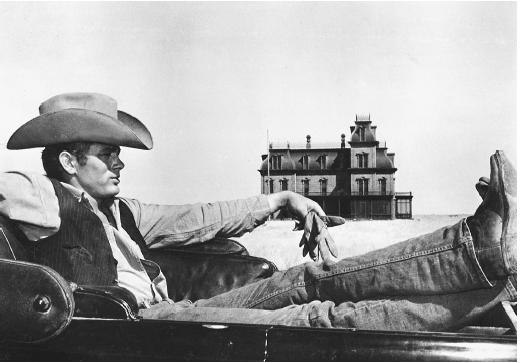
Giant, which was posthumously released in 1956, saw Dean play a 
 supporting role to Elizabeth Taylor and Rock Hudson. This was due to his desire to avoid being typecast as Jim Stark and Cal Trask. In the film, he plays Jett, a surly, racist Texan with a strong prejudice against Mexicans. His role was notable in that, in order to portray an older version of his character in one scene, Dean dyed his hair gray and shaved some of it off to give himself a receding hairline.
Giant would be Dean’s last film. At the end of the film, Dean is supposed to make a drunken speech at a banquet; this is nicknamed the "Last Supper" because it was the last scene before his sudden and horrible death. Dean mumbled so much that the scene had to later be re-recorded by his co-stars because Dean had died before the film was edited.
Coincidentally, the #1 pop song in the US at the time of Dean's death, "The Yellow Rose Of Texas" by Mitch Miller, was also featured in "Giant" in a scene following the actor's last appearance in the film described above.
Dean received his second Academy Award nomination after Giant.
|
President of this Unofficial James Dean Fan Club is Christopher Alexander McCowan

|
